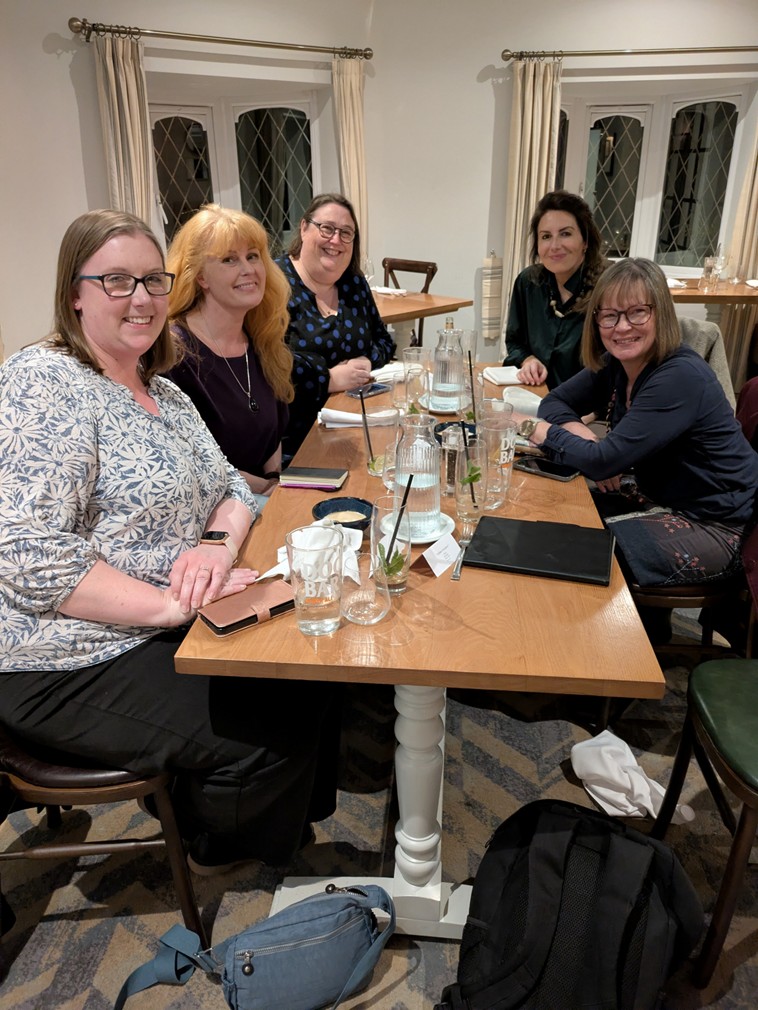
Farmington supports a number of ‘RE Forums’ (or ‘Communities of Practice’) around the UK, allowing practitioners to get together over a meal to discuss matters of common interest in the subject. The Lincolnshire group send this report of their first meeting:
The 2025-26 Greater Lincolnshire RE community of practice met in person for the first time on Tuesday 17th March. We were hosted by Forest Pines Hotel in Brigg and enjoyed a wonderful three-course meal. The participants included two primary school RE leaders (one primary school with 600+ pupils and another primary with just over 100 pupils) and three secondary school RE heads of department located across the region.
Gillian Georgiou had already met the group online to explain the purpose of the community of practice and other ways in which The Farmington Institute provides support for teachers and leaders of RE. She had shared an article co-authored by Dr Martha Shaw and Katie Freeman about personal knowledge in RE, which provided a springboard for conversation during the meal.
We discussed a wide variety of topics. Each person introduced themselves and their context, explaining their key priorities and challenges. We talked about the potential of a National Curriculum for RE, the implications it may have for each of us in our settings, as well as the possible challenges it may present. We explored the recent UK Supreme Court ruling on the parental right to withdraw from RE, how this might change if RE joins the National Curriculum, and our current interactions with parents in relation to the RE curriculum.
Using the Shaw / Freeman article as our starting point, we considered the importance of supporting our pupils to become more consciously aware of their own positionality as part of the RE curriculum. We referenced the reflexivity that is a necessary part of this, noting that this is not something we can take as a given, even from the teachers who are delivering the curriculum. We noted that personal knowledge is not the same thing as describing a personal worldview – we talked about the work of Mikhail Bakhtin and Gert Biesta in exploring the reciprocal nature of dialogue, as well as the work of indigenous scholars, such as Robin Wall Kimmerer, in seeing an exploration of difference and diversity as an opportunity for transformative encounter.
This led us to consider ways in which we can engage our pupils in this critical analysis of their own positionality. Our primary colleagues already work with an RE curriculum that drives learning though case studies – contemporary or historical lived examples of the religious and non-religious worldviews that are being studied. They shared that this approach has had a positive impact on pupils’ engagement, knowledge and understanding in RE, as well as on their self-awareness of their own positionality. Some secondary colleagues were aware of this approach, but it is not yet widely implemented in this context.
We discussed a range of possible case studies that could be used to structure and scaffold learning in RE: the bombing of the 16th Street Baptist Church in Birmingham, Alabama in 1963; the life of Anne Askew, a Protestant Christian from North East Lincolnshire who lived during the Tudor period; Muhammad Ali, a Muslim street artist from the West Midlands who challenges Islamophobia through his work; the Wesley brothers from Epworth, North Lincolnshire and their work in establishing Methodist Christianity; Princess Sophia Duleep Singh, the daughter of the last Maharajah of the Sikh Empire and a passionate advocate for equal rights for women and minoritised people; Mubarak Bala, the leader of the Nigerian Humanist Association, arrested and imprisoned for his beliefs, and so on.
The group – especially secondary colleagues – were excited by the potential of this approach to increase pupil engagement and critical self-awareness. We noted that this approach does not seek primarily to provide pupils with generalised knowledge about religious and non-religious worldviews but instead seeks to empower them by teaching them questions to ask and appropriate methods to use to answer them, so that they can navigate the case study with scholarly rigour. We noted that introducing pupils to a particular lived example can support them to gain a more general understanding of the worldview in focus. This allows us to broaden the range of religious and non-religious worldviews with which we can engage; we mentioned in particular Sentientism, as an alternative example of a non-religious worldview, and Paganism as something rooted in the religious traditions of the UK.
Towards the end of our meal, we started to discuss what this might mean for the ways in which we assess progress in RE. We noted that it is impossible to quantify progression of personal knowledge, as this will be a deeply individual experience for each pupil. We also noted our frustration at whole-school assessment trackers that do not account for the relatively limited contact time pupils have with RE – many of us are required to input data on pupil progress after only 3 or 4 lessons, which is not enough time for pupils to actually make progress. This is a conversation we would like to return to at our next meeting.
Our huge thanks go the Trustees of The Farmington Institute for their generous support of this community of practice. We are grateful for the opportunity to meet together, share our own experiences, support each other and explore what is coming over the horizon for our subject. We look forward to sharing with you an overview of our future conversations.
Gillian Georgiou